研究目的
To demonstrate a turn-key, high-efficient, and compact mid-IR source based on dispersive wave generation with power levels sufficient for spectroscopy application, covering the 3–4 μm spectral region.
研究成果
The presented approach can lead to a very efficient, compact, and easy to use device for coherent mid-IR light generation, covering the 3–4 μm region which hosts the signature of important greenhouse gases. The device provides a power level sufficient for spectroscopy application, bridging the gap between fiber sources and quantum cascade lasers.
研究不足
The spectral reach and efficiency of mid-IR dispersive wave generation in silicon nitride waveguides pumped at telecom wavelength still fall short for practical implementation. The efficiency decreases with increasing dispersive wave wavelength.
1:Experimental Design and Method Selection:
The study leverages recent advances in fiber laser technologies and large cross-section waveguide designs for dispersion engineering and low mid-IR propagation losses. The pump source is a commercial, turn-key soliton self-frequency shifted thulium-doped fiber mode-locked laser.
2:Sample Selection and Data Sources:
The samples consist of 5 mm long straight Si3N4 waveguides buried in SiO2, with four different nominal widths.
3:List of Experimental Equipment and Materials:
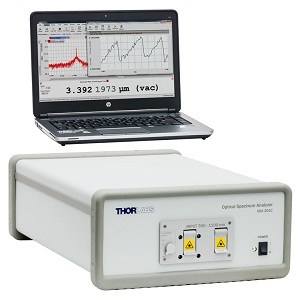
The experimental setup includes a thulium-doped fiber mode-locked laser, variable optical attenuator, aspheric black diamond lenses for coupling, and a Fourier Transform Optical Spectrum Analyzer for recording spectra.
4:Experimental Procedures and Operational Workflow:
Light is coupled into the fundamental transverse magnetic polarization mode of the waveguide. The output light is focused onto a fluoride multimode fiber and the spectra are recorded.
5:Data Analysis Methods:
The mid-IR dispersive wave power is estimated by integration on the FT-OSA, and the on-chip conversion efficiency is calculated as the ratio between the on-chip mid-IR dispersive wave power over the coupled pump power.
独家科研数据包,助您复现前沿成果����,加速创新突破
获取完整内容