研究目的
To propose an iterative algorithm for accurate and simultaneous full-field measurement of temperature and deformation at high temperatures by separating radiation and reflected light using a single camera.
研究成果
The proposed iterative algorithm effectively separates radiation and reflected light, enabling accurate synchronous measurement of full-field temperature and deformation at high temperatures using a single camera. Experimental validation on C/SiC composites shows improved accuracy and extended measurement range, with potential for engineering applications in high-temperature environments.
研究不足
The method assumes constant reflectivity and emissivity across wavelengths (gray body hypothesis), which may not hold for all materials. Simplifications in spectral response functions and potential errors from camera parameters could affect accuracy. The algorithm's performance may vary with different experimental setups and materials.
1:Experimental Design and Method Selection:
An iterative algorithm is designed to separate radiation and reflected light from optical images captured by a color CCD camera. The algorithm uses an improved two-color method for temperature calculation and high-temperature digital image correlation (DIC) for deformation measurement.
2:Sample Selection and Data Sources:
A C/SiC composite specimen with dimensions of 10 × 50 × 50 mm3 is used, subjected to flame heating up to 1000 °C. Images are captured under controlled lighting conditions.
3:List of Experimental Equipment and Materials:
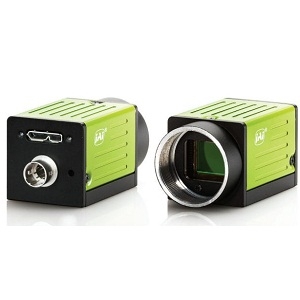
Includes a CCD camera (SP-5000C-USB, JAI), a 50 mm focal length lens, a blue light source, an infrared pyrometer (Raytek-MI3, USA), and an oxy-propane torch for heating.
4:Experimental Procedures and Operational Workflow:
The specimen is heated using an oxy-propane flame; images are captured with and without blue light source. The iterative algorithm processes the images to separate radiation and reflected components, followed by temperature and deformation calculations.
5:Data Analysis Methods:
Temperature is calculated using the improved two-color method based on Planck's law; deformation is analyzed using high-temperature DIC with subset analysis and interpolation techniques.
独家科研数据包��,助您复现前沿成果�����,加速创新突破
获取完整内容