研究目的
To prepare Sm3+, Tb3+ co-doped NaLa(MoO4)2 phosphors with different morphologies and study their temperature sensing characteristics based on fluorescence intensity ratio.
研究成果
The Sm3+, Tb3+ co-doped NaLa(MoO4)2 phosphors exhibit improved temperature sensing sensitivity and relative sensitivity with increased sodium citrate content, due to enhanced defects and electron-phonon coupling. The maximum sensing sensitivity is 0.119 K-1 and relative sensitivity is 0.0193 K-1. The luminescence color changes from green to red with temperature, making it suitable for optical temperature sensing applications. The materials show good thermal stability.
研究不足
The study is limited to specific molar ratios and conditions; samples with Cit3-/Re3+ = 3 were not target products and not studied further. The temperature range is from 303 K to 603 K, and the method may have constraints in other environments or with different dopants.
1:Experimental Design and Method Selection:
Hydrothermal synthesis method was used to prepare Sm3+, Tb3+ co-doped NaLa(MoO4)2 phosphors with sodium citrate as a chelating agent, controlling the proportion of sodium citrate to achieve different morphologies. The rationale was to investigate how morphology affects temperature sensing properties.
2:Sample Selection and Data Sources:
Samples were synthesized with molar ratios of Sm(NO3)3: Tb(NO3)3: La(NO3)3 =
3:
5:
4:7 and Na3Cit:
Re(NO3)3: Na2MoO4 = x: 1: 2 (x = 0, 1, 2, 3). Data were obtained from experimental measurements of XRD, SEM, and fluorescence spectra.
5:3). Data were obtained from experimental measurements of XRD, SEM, and fluorescence spectra.
List of Experimental Equipment and Materials:
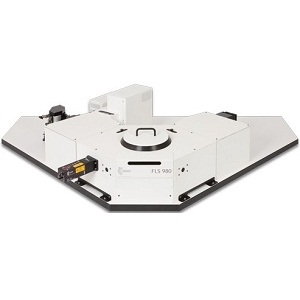
3. List of Experimental Equipment and Materials: Equipment included Rigaku D/max 2600 diffractometer for XRD, Hitachi-SU70 for SEM, Edinburgh Instruments FLS920 fluorescence spectrometer for emission and excitation spectra, and Orient KOJI TAP-02 high temperature fluorescent controller for temperature control. Materials included sodium citrate, rare earth nitrates, and sodium molybdate.
6:Experimental Procedures and Operational Workflow:
Samples were synthesized hydrothermally, characterized by XRD and SEM to determine structure and morphology, and temperature-dependent emission spectra were measured from 303 K to 603 K with 270 nm excitation. Data were analyzed to calculate fluorescence intensity ratios and sensitivities.
7:Data Analysis Methods:
Data were analyzed using equations for fluorescence intensity ratio (FIR), sensitivity (S), and relative sensitivity (SR), with fitting to experimental data using specified formulas. Statistical analysis involved correlation coefficients from fitting procedures.
独家科研数据包,助您复现前沿成果,加速创新突破
获取完整内容