研究目的
To characterize a commercially available laser diode and demonstrate its application in a THz system, focusing on the compensation of the laser's intrinsic chirp to enhance the THz signal amplitude.
研究成果
The characterization of a commercially available laser diode revealed a linear chirp that could be partially compensated using a section of single-mode fiber, leading to a significant increase in the detected THz signal amplitude. This improvement enhances the signal-to-noise ratio and usable bandwidth in noise-limited systems.
研究不足
The study is limited to a specific commercially available laser diode and may not be directly applicable to other types without further research. The improvement in THz signal amplitude is demonstrated in a controlled setup, and real-world applications may present additional challenges.
1:Experimental Design and Method Selection:
The study involves characterizing a laser diode using a stepped-heterodyne measurement technique to determine its complex optical spectrum. The methodology includes comparing calculated instantaneous optical power to measured second harmonic generation (SHG) autocorrelation.
2:Sample Selection and Data Sources:
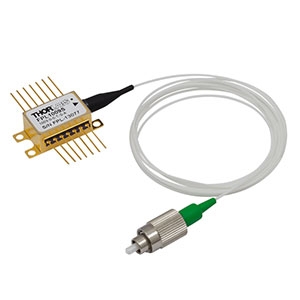
A commercially available Thorlabs FPL-1009P Fabry-Perot laser diode is used, with its output combined with a tunable external-cavity laser for measurement.
3:List of Experimental Equipment and Materials:
Equipment includes an optical spectrum analyzer (OSA), a high-speed photodiode, a digital signal analyzer (DSA), and sections of single-mode fiber (SMF) of varying lengths.
4:Experimental Procedures and Operational Workflow:
The laser's output is combined with a tunable laser, down-converted using a photodiode, and digitized for analysis. Different lengths of SMF are used to compensate for the laser's chirp.
5:Data Analysis Methods:
The complex optical spectrum is analyzed to determine phase and group delay, and the effect of chirp compensation on THz signal amplitude is evaluated.
独家科研数据包��,助您复现前沿成果�����,加速创新突破
获取完整内容